50 Shades of Grey- A Response to the Epidemic

The 50 Shades of Grey Trilogy has taken a lot of the female population by storm. Many women rushed to get the books and fell in love with the mysterious Mr. Grey himself. Internet memes surfaced, making the point that while women may not like porn, they'll certainly read it.


I get it, I borrowed the book from a friend and I don't think I even finished it. I'm not the type to like fictional literature, and quite honestly the sex scenes made me squeamish. I'd rather read something of more value, but to each their own. These books seemed to finally be a way for women to pursue something sexual, and frankly men seemed to be a little uptight about it.

But it's just a book. There are no pictures of nudity. There are no video clips of a woman being degraded in modern internet pornography. Alas, it's a book. A sexual one, but still a book. With no pictures.

Recently the trailer for the movie was released, and all over social media women are posting how either hot they think the actor playing Christian Grey is, or how they are disappointed and a better actor should of been chosen.

I had the pleasure of reading a blog post by Haley Morgan Smith, The Problem with 50 Shades of Grey.

I loved her insight, and her opinions. She brought up strong points about how she would feel if her husband walked in the door, sexualized book in hand, talking of how hot the female actress is, and then later logging on to his Facebook account and posting non-stop about how excited he was to see this super sexy film with the fine actress. She wrote about how this would make her feel- that clearly she'd want to punch him in the throat. I agree with ya, girlfriend.

My point is- don't men do this everyday? Has our society become immune to the "average red-blooded American male" who is not only allowed, but can't help drooling over any attractive woman they see? That women sexualized on TV and the media are just a normal part of it and seeing semi-nude Maxim magazine covers, and even the fitness models now who pose almost naked in the gym. Please tell me, what is the difference?

Pornography is something we cannot escape these days. It's everywhere, and I guarantee 13-year-olds find access to the plethora of XXX websites available these days via the internet. How can these young boys possibly learn to respect women when they constantly see them as sexual objects? Much less, how can young girls respect themselves when they too want to be "wanted" by members of the opposite sex?

Haley's article is very well-written and I truly see her point, that it's wrong and hurtful to betray and objectify anyone else than your significant other. I get that- I just don't think it's fair at all to say that many men haven't been doing that for a long time. So much so, I think it's become natural for our society to accept that men have wondering eyes. After all, they wouldn't be "men" if that's what you call it, without acting that way.
With the internet has come the new way of objectifying women.

According to Caroline Heldman and Lisa Wade, authors of Sexualizing Sarah Palin, since the 1970's the popularity of pornography has led to a higher degree of objectifying women.

"Advances in communication technologies have enabled a new era of objectification, marked by an increasing presence and acceptance of sexual objectification in media, greater pornographic content in mainstream media, and greater acceptance of pornography in the U.S. more broadly" (Heldman, Wade, p. 3, 2011).


Personally, I don't think any person should make their significant other feel small, or unattractive. I would never drop hints or say anything to hurt the man in my life, but I think it's very unfair to say that 50 Shades of Grey has created a problem with women lusting after other men, when it's been happening to women for decades.

Really America, are we just that oblivious?
Heldman, C., & Wade, L. (2011). Sexualizing Sarah Palin. Sex Roles, 65(3/4), 156-164. doi:10.1007/s11199-011-9984-6.

My Advice to an 11-Year-Old About the Modeling World

I was recently asked what advice I would give if I were confronted by an 11-year-old girl and her mother on getting into the modeling industry. It was one of those moments where so many thoughts rushed through my head that I wasn't quite sure where to start, or how to even give a semi-understandable answer.

Flashback 21 years.

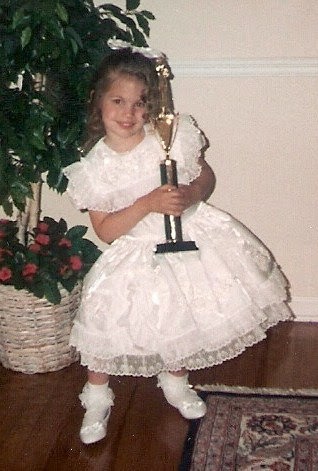
I'm five years old, wearing my first pageant dress, and I have to walk across the stage, smile perfectly, do my turns just as I had practiced, and hope the judges choose me to give the shiny crown to instead of the half dozen or so other shy five year olds with similar bouncing curls and hairdos.


I didn't get the crown, but I did get a pretty tall trophy, which meant the judges must have thought I smiled pretty and did my walk and turns right.

A few years later, around nine years old I enrolled in modeling and etiquette classes. I wanted to be a model when I grew up, and I just knew I was going to be famous. These modeling and etiquette classes gave me confidence walking on a runway and doing local fashion shows at the mall. I had dreams of being "discovered" and found by an agency. I remember an older girl, Tiffany, who was signed by some agency. She might as well have been a celebrity to me, I thought she was so glamorous. She was a model! A real one, and maybe I could be like her.

One night after a fashion show at the mall, Tiffany's mom pointed me out and came over to me. She goes, "That's her! You've got it, you can be just like Tiffany! You are beautiful." I was floored and excited all at once. In retrospect, Tiffany was just your average 14-year-old girl who had a local modeling agency take interest in her. I'm not sure of her whereabouts now, but I'm sure she is living just like the rest of us.

But at that time to me, Tiffany was a supermodel..and I wanted to be just like that.

At 10 years old I prepared for my first modeling convention and competition. I was competing against other hopefuls in swimsuit (yes, at 10 years old) runway, voiceover, commercial and talent. I don't believe I won more than honorary mention, but I was already looking and comparing myself to other girls, both my age and older. I wanted to be the pretty girl, the one everyone liked, the one who was going to be famous...And I knew I would, one day. I was already tall, at 10 years old and 5'2. I would look through the popular magazines and compare myself to what those older airbrushed, women looked like. My cheekbones were high, my lips looked like the girl on this issue of Cosmopolitan, and so on.


 Myself, age 10
 
 Myself, age 12
 
 And thus, the dangerous cycle began. I was always comparing myself to actresses, models, and even in my young pre-teen and teenage years I was already thinking of what I could do to change my looks. Everything from hair color, tanning, cute outfits, plastic surgery- It didn't matter. I saw my body as an imperfect canvas, and that in order to be happy I'd have to actually win contests and have that sex appeal that could guarantee that no guy would ever leave me, and that I had the world in the palm of my hand.


Myself, age 18

According to an article on HuffPost Healthy Living, the National Association of Anorexia and Nervosa and Associated Disorders, I wasn't the only young girl with thoughts like these, and I'm still not. Nearly 70% of girls in grades five through 12 said magazine images influence their ideals of a perfect body.

What those girls don't realize is that those pictures aren't the truth. They aren't reflections of the average woman's body.

When I got into college, I took the modeling competitions up a notch. I started participating in more photoshoots with anyone that I thought could take some real photos, and I primarily just used those pictures for my social media profiles. I thought a hot looking profile picture would mean more people would like me. I also thought the more swimsuit competitions I participated in and won, the happier I was going to be.

 
Myself, age 23, Swimsuit USA competition in Playa Del Carmen, Mexico

Swimsuit competitions started to become what I revolved around. I thought it spoke of me as a better person, someone that other girls were envious of. I thought the better I looked, the better I actually was. In reality, when I was winning these contests and regarded them as a hobby and a job, all I was doing was comparing myself to other women. If I didn't place in a contest, I thought maybe it was because I was too tall. Maybe I was too big- maybe I should have dieted more. Maybe I didn't do my hair right...or...maybe they ARE prettier than me. Maybe I should do something drastic about it.

You see, starting in the modeling industry gave me a sense of false confidence. It's false, because you're basing your self-worth and happiness on something so superficial. That's not happiness.

The older I got the more I realized that maybe these issues of constantly wanting to change my appearance were a little deeper than I thought. During an international competition in Las Vegas, NV one year, I realized that even dieting wasn't going to help my waist look any slimmer- the only choice I'd have at looking more petite is to have a rib removed, creating a smaller rib cage and waistline. Now of course, this was just a thought, but it signified something much bigger. I began to realize at this point I had fallen into body dysmorphia.

According to the Anxiety and Depression Association of America, people who suffer from body dysmorphic disorder take their perceived flaws to the extreme. They can't control their negative thoughts of their physical appearance, no matter what others may say. To the sufferer, the perceived flaw causes much emotional distress, and they may go to any length to correct the "problem," or even avoid social situations altogether.

Rachel Scherdin, registered dietitian, also knows first-hand what can happen when young girls pour their self-worth into the modeling industry.

"It's a destructive environment. It's a breeding ground for negative body image, as you are constantly comparing yourself to others and being compared to other models. What once used to be fun starts becoming an obsession."

Jessica Lundy, a successful promotional model and National Physique Committee fitness competitor says she personally didn't start modeling until she was old enough to understand the industry.

"I would never push it on my daughter, but if it was something she wanted to do I would just know to do my research with everything. I would also advise her to remain balanced and grounded, and to always know who you are and what you want."

Now, back to the 11-year-old wanting to break into the modeling industry.

My advice to you: know who you are and what makes you happy. Don't compare yourself to others, life isn't a competition based on looks. Focus on being happy and healthy, and don't worry about how you look. Looks are not going to bring happiness, I promise you. Focus on doing what you love, participate in sports, excel in school. Make your goals something you can obtain, not something where you depend upon the judgement of others.

Women have been objectified for decades as sexual objects. It's our job to help turn that around.

Kendall Jones Taking on the Wild...and Social Media

I absolutely love animals. Seriously, I can't kill an insect without feeling bad about it. While many people view snakes as awful creatures, I don't see the need to stab one to death just because you see it somewhere in your yard. I mean, if it's coming at you, that's a different story, but if Mr. Snake is just hanging out trying to survive, ya know..just like YOU are...let him be.

I will admit that I am a crazy cat lady, I adore my two cats children, and I have such respect for the larger members of their species...Although I am disgusted when I watch National Geographic and watch my beloved big cats go after that cute, harmless Gazelle...I digress, It's all apart of the food chain. But I hate seeing it.


My stance on hunting and not being a vegetarian is a sensitive subject, typically I don't bring it up because it is just that, an opinion. I do not think hunting is attractive, I do not think it's a sport, and the nicest way I can put it is I understand people have their "hobbies" if that's what you call it. I personally don't think hiding in a bush, camouflaging yourself and waiting for an unsuspecting animal to creek into your path is a sport, but do what you will. Nothing I say or do will stop that.

Do I eat meat? Yes, unfortunately. I limit what meats I eat and I disconnect myself from what the meat actually is and how it turned into the filet on my plate. I get it- we eat it, I just don't like the idea of the sport.

Which brings me to my point....Kendall Jones, the cheerleader chick all over social media posing with dead lions, leopards, rhinos and other animals from her "in the wild hunts."


Disgusting.

I personally was horrified to look through the pictures, to see that someone would willingly take the the life of such great animals for a sport..and worse, smile by the dead bodies and take a picture. Honey, you wouldn't be smiling if they were chasing you and you were weaponless. Totally not fair.

According to an article on Buzzfeed.com, Jones says her murdering hunting efforts are all a part of conservation, and the villages actually benefit from the thousands of dollars she pays to murder hunt these animals.

I'm not going to act oblivious- I know this happens. Since there isn't much I can do, I try to turn a blind eye. My problem with Miss Jones are the pictures she's posting on social media sites. I understand you want to fulfill this hobby of yours, but posting the graphic photos are a bit hard to stomach for me. 

On the contrary, many people signed pledges to have Jones' pictures removed from Facebook- they went all out. There was even a pledge to have her banned from the country she was hunting in. 

Here's Where I'm Divided

I hate the hunting part, as stated earlier...But there's a bigger picture that perplexes me. Facebook may remove the images, but that doesn't stop the act. Kendall will still be murdering hunting, and I'll still be sitting on my couch cringing everytime I turn on National Geographic and watch the beautiful Lioness eat the beautiful Zebra.

So while the pictures may not be on social media for all to see, I think we should all be aware that this is a real thing that happens, no matter how many pledges are signed or death threats she may recieve. She made the unpopular choice to get the quick gain to infamy by posting the pictures on Facebook...And as far as I know now, that's the only thing that has been removed. Just some pictures on Facebook..Until then, she will have a show airing in 2015...

And I, nor my cat Frank or Reese (not pictured) will be watching.


Why we Shouldn't #FreeTheNipple

I'll admit I do hold feminist views, but there are some things I do not agree with. Recently, exposed female nipples in public have been all over the media, from breast feeding in public to Rihanna's see-through tops. Now, some women have started the #FreeTheNipple campaign in hopes to bring about gender equality. 

According to an article on The Huffington Post, creator of the #FreeTheNipple campaign, filmmaker Lina Esco says the movement isn't about encouraging women to walk around naked, it's about bigger issues.

Just to be clear, they are looking for are the same rights as men to go without a shirt if they'd like, as well as get rid of the rape culture and slut shaming. I agree those are serious issues, but I'm not too sure on their tactic.


Scout Willis

I don't think a woman exposing her breasts is the way to go as far gender equality. I understand breasts are for breastfeeding, but I still abide by the rule that there is a time in a place for everything. Whether women want to agree with this or not, women's breast are very sexually objectified. 

I don't believe there should be any desire for women to want the right to go topless, because it's not sending the right message no matter how you angle it. A woman's body is different than a man's, there are areas that are more sensitive to others. Sure, there's a long way to go in order to  have gender equality, but walking around topless isn't the answer.

No matter what anyone says, a woman baring her breasts will always be looked at in a very sexual nature. I feel that many men would laugh and say that's okay with them- but the reality of it is that no "message" is being received other than checking out a topless chick.

For those who want to support the campaign but don't want to actually go bare-chested, there is a new bikini top you can buy.

The Tatatop


The Tatatop is a bikini top made of a flesh colored spandex with nipples, that makes the wearer appear to be topless. The Tatatop was created for women to support the #FreeTheNipple campaign, without actually going topless. A portion of the cost goes to the Lynn Sage Cancer Research Foundation.

 What are your thoughts on the #FreeTheNipple campaign? Do you think it is a good way for women to achieve gender equality?

Miss Indiana and her "Normal" Body

With all of the buzz flooding around Miss Indiana's "curvier," "thicker" and "normal" body, I wanted to take a step back and look at what society is actually doing here.

Yes, I tuned into the Miss USA pageant last Sunday night. Growing up as a little girl I loved watching pageants on TV, but I'll be honest- I was debating watching this debacle. Not to completely bash pageants, but I do know what it's like competing in them and the idea it gives society, as well as the women in them. Not to mention, not all pageants are as sugary sweet as they seem to be.

So let's say you make it as big as the Miss USA pageant- a really big feat. How does the rest of society look at this? I know by the flooding on social media, everyone was rooting for the contestant that represented their home state, and, of course, who they thought was the best looking.

Because in beauty pageants, the best looking is the best choice.

In this type of atmosphere people are drawn to be supportive of whoever the most beautiful contestant is. It's all about the hair, the makeup, the slender body. Women being paraded around based on their beauty. I know, there is an educational and philanthropic aspect to it, but in beauty pageants, if you don't have the look, you don't have a chance.

From being a woman and knowing body sizes, I can easily tell most of the women in the Miss USA pageant are easily a size 0, maybe a 2. I can tell from the slender waist lines and bone structure even just from a TV. Miss Indiana 2014, Mekayla Diel displayed a shape much smaller than the average American woman, and has received more attention for having a "normal" size body than the winner of the pageant did for winning.


Okay for one, how is this shape "normal?" How can anyone's body be classified as "normal?" Also, it is widely known that Miss Indiana's shape is not the size the average American woman is.

Oh, but wait. This is a beauty pageant.

This is what society is lead to believe- that in order to be beautiful a woman must be very tiny, have a nice round butt (no cellulite please) a nice bosom (no breast implants, only natural, but they can't be too small) and 6 pack abs (not too manly though) with nothing extra.

And society loves this. Many women continually bash their "normal bodies" because their stomachs aren't completely flat. They aren't the same size they were several years ago, and they don't look like the hottest Hollywood actress.

I don't expect society to change, but what we can do is create awareness and teach ourselves, our daughters and our sons that true beauty is much more than skin deep. After all, who more do they look up to besides you?


Your Online Self vs. Your Actual Self

An interesting topic came up in my communication class last week about social media networks, and I couldn't quite come up with a definite answer:

How do you self represent online? Are there differences between your "online self" and "actual self?"

Mind blown.


It's such a simple question when you first look at it, and I thought immediately that of course my "online self" was different than my "actual self." Online, you only see the same non-emotional status updates that I think are few and far between, occasionally some pictures of my cats or a community event...and oh, running and grad school. You will see some of those on there as well.

What you do not see is what goes on behind the scenes. You will not know how I'm feeling that day, if I'm sad or upset, and you won't know what's really bothering me. You won't know if I've had a stressful day and went to sleep crying. You won't know what's really going through my mind.

Here's the crazy part though: isn't that the same way I am with my actual self?

I am by nature an introverted person. Unless you are very close to me, you won't know what kind of day I'm having anyway. You know just as much as what my online self would allow you to know: that I attend graduate school, I run a lovely little blog titled Creating Confidence, and that I'm attempting to be a runner. That's about it. So isn't this the same? I feel that my online self is the same reflection of my actual self.

Let's take a step back for a second.

We all know those people who post their entire daily lives on social media, in fact, you may be one yourself. Have you ever had a "friend" who is constantly on social media sites, posting non-stop, then when you see them in person they don't say much at all? More than likely they are probably too busy responding to Facebook message and Twitter updates. I feel that while social media networking sites have made it easier in a sense to be"connected" to people you haven't seen in years and might not even recognize in person, but it has left a void where face-to-face communication should be. It's made it easier to get the news and to feel closer to different organizations and brands. Heck, if you are displeased with a product or company, simply write something negative on their social media sites and look how fast you will get a response...But what are missing out on here?

There's a quote I heard about a year ago that has stuck with me when it comes to social media networking sites and what people promote about themselves. 

The reason we struggle with insecurity is because we compare our behind-the-scenes to everyone else's highlight reel.
It's certainly easy to do, especially since you're only seeing a version of what people only want you to see online. You won't see me posting about a bad day I've had or any of my own personal fears- that doesn't mean I don't struggle with them daily. You only see what people allow you to see online. Online, you can construct a different identity if you'd like to, and face-to-face communication is slowly getting away from us.

How many times have you been to a restaurant and watched people glued to their phones and not talking to one another? How many times have you communicated with someone online, to barely speak a few words to them in person? How many bits of personal information do you know about someone you haven't seen in years? It's crazy.

What are your thoughts? What do you choose to share with people online, and do you feel that your "online self" differs from your "actual self?"

What are the Dangers of Posting Negative Comments Anonymously Online?

While social media sites such as Facebook and Instagram may not be anonymous, ever since thedirty.com debuted, tons of websites, apps and other social media sites have been created for the online troll to anonymously bash whoever they wish.


Anyone can upload comments of some poor unsuspected soul and trash talk them anonymously, along with their victims full names and several pictures. Then of course the dozens upon dozens of comments from other anonymous trolls after that.

But The Dirty isn't the only one out there. There is one that markets to college kids.

I recently learned of the app Yik Yak, developed primarily for college kids to post anonymously within a 2 mile radius of their current location. It's like Twitter, except there are no screen names and anyone with the app in that area can post whatever they wish. And they definitely are. 

I apologize in advance for the comments in the picture below.
 Pat Taft, employee at Queens University of Charlotte says the app Yik Yak is the most recent app where students can post anonymously. 

"There is a contingent of college students that will post anything and everything. When they think it is anonymous they do have a filter. They will post ugly messages using the other person's  name. They have no concern for feelings. They also use a lot of profanity. They will ask individuals to meet them in certain places to have sex and exchange drugs. This is not just Queens. I have observed this at other institutions as well," said Taft.

However, there are some restrictions to the app. Yik Yak will remove a comment if it receives five or more people that dislike it. 

"I posted that some thoughts should never leave your brain and that Yik Yak will probably turn out not to be anonymous and it will affect people getting jobs - it was off within one minute," said Taft.
While Yik Yak shows comments from users within a 2 mile radius of where you are logged in, Taft says the app does not speak well for a University.

"Students at other schools and neighbors can see the information. Yik Yak has been disturbing because students have talked about the administration, faculty and peers in a negative manner using specific names. You sure can tell what they think about certain classes," said Taft.

So what can we do about this?

In my opinion, this is not new and it will certainly not be the last app or website that allows people to speak their minds anonymously. People as a whole need to stand up and speak out against this kind of behavior and understand that it gets you no where.
As an employee at a University, Taft has this bit of advice to offer college students.

"Assume that nothing is anonymous! Do not post anything that you would not mind a future employer reading. Also, if you cannot say it to someone's face, then you should not say it online. 
They need to understand that just because they cannot see hurt feelings, crying, and depression from their remarks it does not mean they are not there. What they post is a reflection of themselves.  They should ask the question, 'How am I going to be perceived?' before pushing the send button."

What do you think about websites and app such as The Dirty and Yik Yak? What do you think people get out posting negatively about others and what, if anything, do you think can be done about it?

 
Blogging tips